THE LAST WHITE LOCKER ROOM

Hockey's Olympic moment, a presidential phone call, decades of institutional impunity — and a window of grace that is closing fast.
February 24, 2026 — Updated
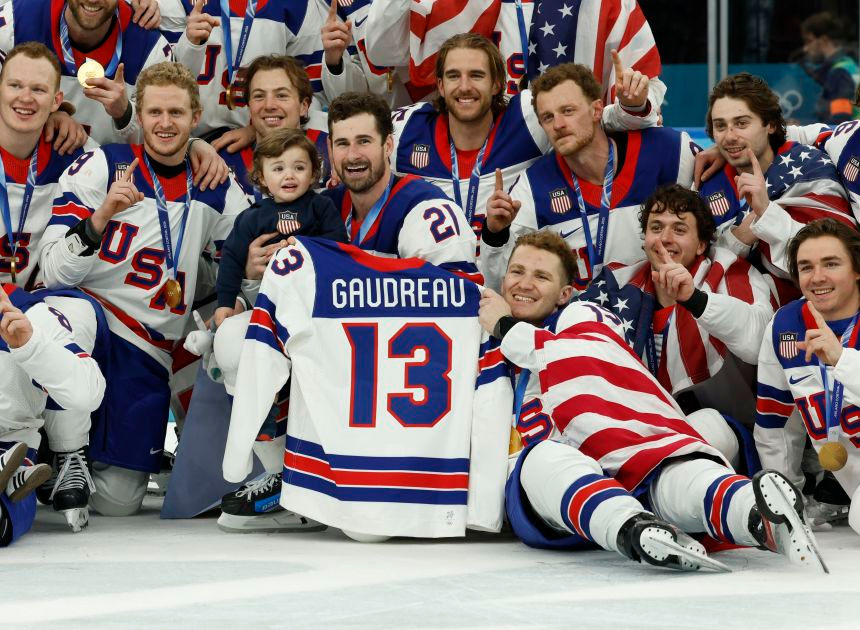
On the evening of February 22, 2026, in a locker room in Milan, Italy, the United States men's hockey team received a phone call from the President of the United States. They had just won Olympic gold for the first time in 46 years. FBI Director Kash Patel held up the speakerphone. Players roared. Trump offered a military plane. He offered the State of the Union as a stage.
Then, almost as an afterthought, the President said: "We are going to have to bring the women's team, you do know that. I do believe I probably would be impeached."
The men laughed.
The women had won gold three days earlier.
By Tuesday, the story had fractured along predictable lines. The women's team declined Trump's State of the Union invitation, citing scheduling conflicts — a statement of such precise diplomatic understatement that it required no elaboration. Twenty men from the team went to the White House, posed for photos in the Oval Office, and attended the speech. Five did not: Jake Guentzel, Kyle Connor, Brock Nelson, Jake Oettinger, and Jackson LaCombe. Their stated reasons were professional — all five had NHL games the following night. None publicly cited the women's controversy.
A MoveOn petition with nearly 20,000 signatures called for a public apology.
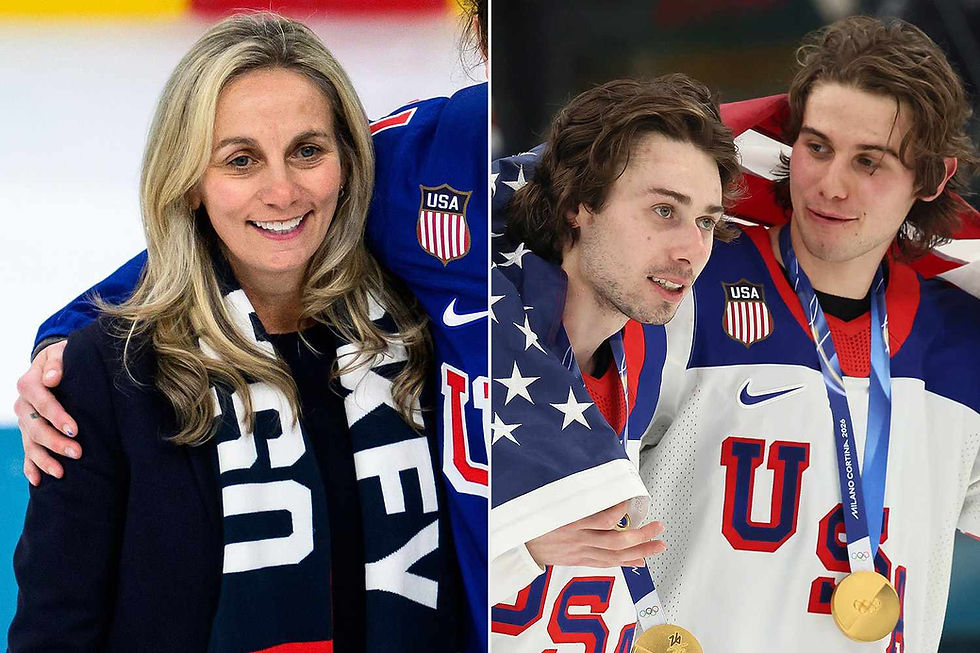
Ellen Hughes, mother of Jack and Quinn Hughes and a player development consultant for the U.S. women's team, appeared on the TODAY show and said "at the end of the day, it's just about the country." Her sons appeared shortly after and praised the camaraderie between the teams.
Nobody apologized. Nobody said they were uncomfortable. The window for grace opened quietly, and so far, it is still open.
The locker room phone call lasted minutes. What it reveals has been building for decades. But the response to it is still being written.
BEFORE THE INDICTMENT: A CASE FOR GRACE
The Laugh That Doesn't Mean What It Looks Like
Before we go further — before the statistics, the secret funds, the acquittals, the racial arithmetic of a sport that has always known exactly who it was built for — something needs to be said about the men in that Milan locker room. Something that the clip, and most of the commentary around it, has conspicuously not said.
They may not have wanted to laugh.
This is not an exculpation. It is an observation that the science of social behavior — and the testimony of countless women who have survived similar moments — makes unavoidable. The laugh that travels through a room when a powerful person makes a degrading joke is not always the laugh it looks like. Researchers call it the fawn response: the nervous system's calculation, usually below conscious awareness, that appeasement is safer than resistance. Your body reads the room — the power dynamics, the social stakes, the cost of dissent — and it acts before your mind has a chance to catch up.
Women who are being harassed know this intimately. Studies consistently document that women laugh, smile, and perform enjoyment in situations they find threatening or degrading — not because they find them funny, but because their nervous systems are running an ancient and accurate program: defuse the threat, maintain the relationship, get out of this intact. Seventy percent of people who experience sexual assault report tonic immobility — a freeze or fawn response that, from the outside, can look exactly like consent. The woman at the center of the Hockey Canada trial was asked, repeatedly, why she did not just leave. She was experiencing what researchers now understand as a completely predictable neurological response to perceived danger.
Men are conditioned to perform the laugh. Women are conditioned to survive it. In a room with the President of the United States on speakerphone, both instincts can fire simultaneously.
Men are not exempt from this dynamic. They are subject to a different version of it — one trained not by fear of physical harm, but by the iron social logic of the locker room. Research led by psychologist Emma O'Connor at Western Carolina University found that men with rigid beliefs about masculinity are significantly more likely to laugh at sexist jokes when their place in a social hierarchy feels threatened. The setting of a professional sports locker room, with a head of state on the line and cameras recording, is precisely the high-stakes environment in which the performance of correct masculine behavior becomes automatic.
You laugh because not laughing is a declaration. Not laughing says: I am not one of you.
Bell hooks, in The Will to Change — her most compassionate and least-read book — described the first violence that patriarchy demands of boys not as violence toward women, but as something that happens before that: the killing off of their own emotional honesty.
"Learning to wear a mask," she wrote, "is the first lesson in patriarchal masculinity that a boy learns. He learns that his core feelings cannot be expressed if they do not conform to the acceptable behaviors sexism defines as male. Asked to give up the true self in order to realize the patriarchal ideal, boys learn self-betrayal early and are rewarded for these acts of soul murder."
The laughing men in that locker room were rewarded. The moment they laughed, they were safe. Inside the system. Part of the team. That is precisely how the system perpetuates itself.
Patriarchy is not just a women's problem. It is the thing that required those men to betray themselves on camera, while the whole country watched — and then rewarded them for doing it.
But here is what the system cannot take from them: the knowledge of what they actually felt. And if any player in that locker room felt a flicker of discomfort — if any of them registered that what the President was saying was wrong, and laughed anyway — then they are living in the space that bell hooks identified as the beginning of change: the recognition of the mask.
The five players who declined the White House visit cited NHL scheduling. That may be the whole truth. It may not be. Either way, the decision not to stand in the Oval Office for a photo is different from the decision to say out loud why you didn't want to. The first is absence. The second is accountability. What the 20,000 people who signed a petition asking for a public apology understand — and what Ellen Hughes's careful pivot to "unity" cannot fully obscure — is that the women's team deserves more than a scheduling conflict. They deserve the words.
What would that look like? Not a press conference drafted by a publicist. Something simpler and more human: an acknowledgment that in a room full of powerful men, with the most powerful man in the country on the line, laughing was the path of least resistance, and they took it, and they wish they hadn't. That they knew, somewhere underneath the reflex, that the women who beat Canada three days earlier deserved more than a punchline. That patriarchy costs the men inside it something too — their own honesty, in a room where honesty would have mattered.
That kind of honesty is not weakness. In a locker room culture built on its suppression, it is the most consequential thing a man can do.
The next generation of hockey players is watching. The system persists because the men who feel the discomfort don't say so. It changes when they do. The window is still open. Not for long. But it is open.

Women as Afterthoughts and Punchlines
The most revealing thing about Trump's phone call was not what he said. It was the sequence. The U.S. women's team had won gold on February 19th — defeating Canada in overtime, in what would become the most-watched women's hockey game in history. The White House posted a congratulatory tweet. No military plane. No speakerphone call. No FBI Director flew to Italy for their game.
Three days later, the men won. The phone rang within hours.
When the formal invitation to the State of the Union was eventually extended to the women's team — almost certainly as damage control after the clip went viral — a spokesperson confirmed both teams had been "formally invited by the administration." The women were not told about the invitation until late Sunday night. They were still on a commercial flight home. The men had a charter to Miami.
The President framed their inclusion as a political liability. His audience laughed. And twenty of the men, two days later, went anyway.
The asymmetry is structural. It reflects the way women's achievement in hockey has always been processed by the institutions that nominally support it: as an obligation to be managed, a liability to be contained, a box to be checked. The NHL remains the only major professional sports league in North America without a formally codified domestic violence policy. Its own first-ever internal diversity report found the league's total workforce 84 percent white. Women, despite constituting 40 percent of the fanbase, hold senior leadership roles in vanishingly small numbers.
These are not failures of individual character. They are accurate readouts of institutional priorities.
Institutional Protection from Accountability
In June 2018, Canada's gold medal-winning World Junior hockey team gathered in London, Ontario, for the Hockey Canada Foundation Gala. A 20-year-old woman alleges that she was taken to a hotel room, that seven more men entered without her knowledge or consent, that they brought golf clubs to intimidate her, and that over several hours she was subjected to degrading sexual acts while she tried to leave and was prevented from doing so.
She reported what happened. Police launched an investigation, then closed it in early 2019 without charges. In 2022, she filed a civil lawsuit. What the lawsuit revealed was more damaging than the allegations themselves: Hockey Canada had known, had quietly settled, and had done so using a secret fund — financed in part by the registration fees of children playing youth hockey across Canada — that had paid out 21 sexual misconduct settlements since 1989 with no public disclosure. The fund totaled approximately C$7.6 million.
The fund was not a rogue operation. It was a policy. A decision made over decades at the highest levels of the sport's administration.
Parliamentary hearings followed. Hockey Canada's CEO stated he had no plans to resign, then resigned along with the entire board. Almost every major corporate sponsor suspended or terminated their relationship with the organization. Five players were eventually charged in 2024 and acquitted in July 2025, when Justice Maria Carroccia found the complainant's testimony not "credible or reliable." What is not disputed: a player sent a group text to 18 teammates asking who wanted to join a sexual encounter. He lied to police. After-the-fact "consent videos" were made. Text messages suggested the players coordinated their accounts before speaking to investigators. None of this was sufficient, under the law as the judge applied it, to convict. It was sufficient to reveal a culture that the sport's governing body had spent decades quietly subsidizing.
The Justice Gap
The acquittal is not an aberration. A 2014 Lakehead University study found that problems in hockey "include, but are not limited to: multiple types of sexual violence, hazing rituals, drug abuse, and various forms of prejudice and discrimination." A 2012 Boston University task force found a culture of "sexual entitlement" and alcohol abuse embedded in the men's program.
"I thought saying no, I don't want to do this and physically pushing him off of me was enough. What else did I have to say?" — The complainant in the Hockey Canada trial, under cross-examination.
The justice gap is widened by what happens to women who come forward. In the Hockey Canada trial, the complainant was cross-examined for days. She was asked why she had gone to the player's hotel room. Why she hadn't left. Why she hadn't fabricated a medical excuse. The judge found her not credible.
When institutions treat sexual misconduct as a reputational liability to be managed rather than a harm to be addressed, they signal to everyone inside them what kind of behavior will be tolerated. The NHL called the Hockey Canada findings "disturbing" and "unacceptable." It declined to release its own year-long investigation until after the criminal trial ended. It then, largely, moved on.
The Last White Sport
To understand why hockey's culture has proven so intractable, it is necessary to understand what kind of institution hockey actually is. It is the most racially homogeneous major professional sport in North America, by a margin that is not close.
As of the 2024-25 season, approximately 90 percent of NHL players are white. Black players constitute roughly 3 percent of active rosters — about 34 individuals in a league of over 700 players. Indigenous players number fewer than ten. By comparison, the NFL is 70 percent Black, the NBA 83 percent. The NHL's own first diversity report confirmed its entire infrastructure is 84 percent white. According to survey data, 92 percent of NHL viewers identify as white.
Hockey is not just the whitest major sport. It is a sport that has built whiteness into its economic architecture — and reaped the cultural consequences.
Youth hockey is among the most expensive sports in America — some families spend up to $19,000 per year on equipment, ice time, league fees, and travel. The USA National Team Development Program spends an average of $92,000 per player annually. In a country where the wealth gap between white and Black families remains as wide as it was in the 1960s, a $19,000 annual barrier to entry is a racial filter.
Race, class, and gender are not separate axes of analysis. They operate together. The culture that has enabled the systematic protection of male athletes accused of sexual assault is the same culture that has maintained the sport's racial homogeneity. Both reflect the same underlying logic: the institution exists primarily to serve and protect a particular kind of person. When Hockey Canada spent C$7.6 million from a secret fund to settle sexual assault claims, it was protecting athletes who were, in nearly every case, white, wealthy, and on the path to professional careers worth multiples of that amount. The women who filed those claims were not part of that calculus.
The same institutional logic that excluded Black players for generations protected its abusers. Both are expressions of the same thing: a closed world that decides who counts.
Coda
The U.S. women's hockey team declined the State of the Union invitation citing "previously scheduled academic and professional commitments." Many of them are amateur athletes balancing careers and graduate programs. They flew home commercial. They found out about the invitation late Sunday night.
The men who were in that locker room — and felt something, even briefly, when the president made his joke and the room filled with the sound of men performing safety — still have a chance to say so. Not for the women's sake. For their own. Patriarchy extracts a price from everyone it touches, including the men who benefit from it. It required them, in their most triumphant moment, to betray themselves on camera.
Bell hooks called that cost "soul murder." She did not mean it as a metaphor.
The petition has 20,000 signatures. Ellen Hughes talked about unity. The five players who stayed home cited their schedules. The twenty who went posed with their medals.
Somewhere in that accounting is a man who knows what he actually felt in that locker room. The window for saying so is still open. It will not be open much longer.
Hockey will produce another scandal. The next fund will be discovered, the next trial will end in acquittal, the next woman will be asked why she did not just leave — unless the men inside the system decide to do something it has never rewarded them for doing.
— February 24, 2026
SOURCES & REFERENCES
This article draws on breaking news reporting, peer-reviewed academic research, parliamentary testimony, court records, and published books. All news sources were accessed February 22-24, 2026. Where statistics have been updated by more recent reporting, the most current figure is used.
Breaking News & Press Coverage
NBC News / TODAY Hughes Brothers' Mom Responds to Controversy. Feb. 24, 2026.
NBC News U.S. men's hockey team expected to attend Trump's State of the Union. Feb. 24, 2026. Reporters: Monica Alba, Megan Lebowitz, Kyle Stewart, Lizzie Jensen.
NBC News Trump ignites culture war around U.S. hockey gold medal winners. Feb. 24, 2026.
NBC News U.S. women's hockey team declines Trump's invitation to the State of the Union. Feb. 23, 2026.
CNN US women's hockey team declines Trump's State of the Union invite, citing scheduling. Feb. 23, 2026.
PolitiFact In Context: What did Trump say about inviting US women's hockey team to the SOTU? Feb. 23, 2026.
The Associated Press Women's team travel logistics and invitation timing. Cited in PBS NewsHour, Feb. 23, 2026.
Daily Faceoff Multiple U.S. men's Olympic hockey players decline White House invite. Feb. 24, 2026.
ClutchPoints The 5 USA players not attending State of the Union on Tuesday. Feb. 24, 2026.
Bring Me The News 3 Wild stars visit Trump at White House; 4 with Minnesota ties decline. Feb. 24, 2026.
The Hockey News Stars' Jake Oettinger Skips White House Visit. Feb. 24, 2026.
Yahoo Sports / The Athletic Kyle Connor quote on returning to play. Reporter: Murat Ates. Feb. 24, 2026.
The Mirror US Petition calls for USA men's hockey team to snub Donald Trump invite. Feb. 23, 2026.
Newsweek US Women's Hockey Team Declines Trump's State of the Union Invite. Feb. 23, 2026.
Hawaii News Now / Gray News US men's hockey team gets backlash for phone call with Trump. Feb. 23, 2026.
The Daily Beast U.S. Women's Hockey Team Rejects Trump's Two-Faced Invite. Feb. 23, 2026.
Hockey Canada Scandal — Primary Reporting
Al Jazeera Canadian hockey has a rape problem. Sept. 3, 2022.
The Conversation Hockey Canada sex assault verdict: Sports culture should have also been on trial. 2025.
Policy Options (IRPP) Consent confusion and the Hockey Canada sexual-assault trial. Sept. 10, 2025.
ESPN Hockey Canada sexual assault scandal: Timeline of events. Feb. 6, 2024. Reporter: Kristen Shilton.
CBC News Crisis on ice: What you need to know about the Hockey Canada scandal. 2022.
CBS News Five former players of Canada's junior hockey team acquitted by judge. July 25, 2025.
Al Jazeera Judge rules former Canadian hockey players not guilty of sexual assault. July 24, 2025.
ABC News NHL players from sexual assault case not offered contracts. July 1, 2024.
Academic Research & Peer-Reviewed Sources
O'Connor, E., Ford, T. E., & Banos, N. Restoring Threatened Masculinity: The Appeal of Sexist and Anti-Gay Humor. Sex Roles, Springer, 2017. DOI: 10.1007/s11199-017-0761-z
Core research on precarious manhood beliefs and sexist humor as masculinity restoration.
Therapy in a Nutshell Fawn/appease trauma response and tonic immobility in sexual assault (70% figure). therapyinanutshell.com, 2025.
Trauma Geek Fawn: The Trauma Response That Is Easiest to Miss. traumageek.com, 2021.
Based on polyvagal theory (Dr. Stephen Porges) and Dr. Arielle Schwartz.
PMC / NIH An Exploratory Investigation Into Women's Experience of Sexual Harassment in the Workplace. PMC10248292.
NCBI Bookshelf Sexual Harassment of Women: Climate, Culture, and Consequences. National Academies Press, 2018.
Lakehead University (2014) Study on social problems in hockey culture, including sexual violence and hazing. Cited in The Conversation.
Boston University Task Force (2012) Report on sexual entitlement culture in men's hockey program following sexual assault charges.
Hockey Graphs (2020) Racial Bias in Drafting and Development: The NHL's Black Quarterback Problem. July 22, 2020.
Includes interview with Jean-Luc Grand-Pierre; research by Courtney Szto, Queen's University.
FiveThirtyEight (2020) The NHL Says Hockey Is For Everyone. Black Players Aren't So Sure.
Yahoo Sports (2020) The Privilege of Play: Hockey's racist and affluent culture still hasn't changed. Sept. 29, 2020.
NHL First Diversity & Inclusion Report (2022) Accelerating Diversity & Inclusion. Reported by ESPN.
LeagueApps / NextGen AAA (2019) Removing The Participation Bottleneck In Elite Youth Hockey. Includes NTDP cost data.
Nielsen / Sports Demographics NHL viewership demographics (92% white). Reported in Pacific Standard and FiveThirtyEight.
Books
hooks, bell The Will to Change: Men, Masculinity, and Love. Atria Books, 2004.
Primary source for soul murder concept, patriarchal masculinity, and mask of masculine identity.
Moore, Evan & Shaw, Jashmina Skating on Thin Ice: Professional Hockey, Rape Culture and Violence against Women. Cited in The Conversation, 2025.
James, Valmore & Gallagher, John Black Ice: The Val James Story. ECW Press.
Parliamentary Testimony & Legal Records
Standing Committee on Canadian Heritage Parliamentary inquiry into Hockey Canada's handling of the 2018 sexual assault allegation. July 2022, Ottawa.
Ontario Superior Court of Justice R. v. McLeod et al. Justice Maria Carroccia presiding. Verdict: July 24, 2025. London, Ontario.
Ontario Superior Court of Justice Statement of claim filed by E.M. against Hockey Canada and eight players. April 2022. $3.55 million in damages sought.
Reference & Public Record
Wikipedia Hockey Canada sexual assault scandal. Last updated 2026.
Wikipedia Misogyny in ice hockey. Last updated 2026.
Wikipedia Race and ethnicity in the NHL. Last updated 2026.
MoveOn.org Petition calling for public apology from U.S. men's hockey team. Approx. 20,000 signatures as of Feb. 24, 2026.
Social media (Bluesky, X) Public commentary: Shannon Watts, Keith Olbermann, Dominik Hasek, Bruce Arthur (Toronto Star). Feb. 22-24, 2026.
Statistics on NHL demographics, youth hockey costs, and fan demographics are drawn from multiple corroborating sources and represent figures current as of 2024-25. The C$7.6 million Hockey Canada figure is from parliamentary testimony confirmed by multiple news organizations. The 70% tonic immobility figure is from clinical trauma literature replicated across multiple studies. All direct quotations from named individuals are sourced to the publications listed above.


Comments